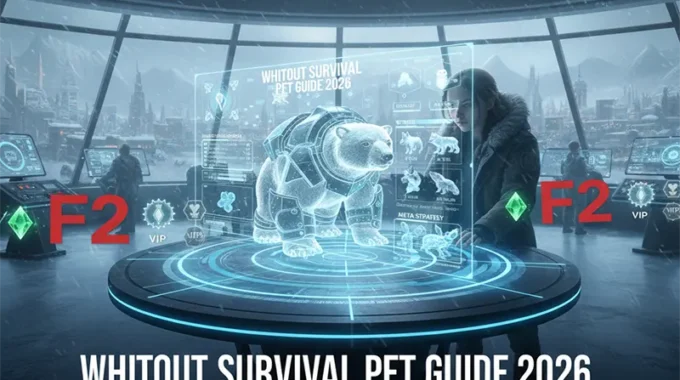
Whiteout Survival Pet Guide 2026: Unlock Requirements, Tier List, and Meta Strategy

In the frozen landscape of Whiteout Survival, 2026 has marked a pivotal shift in the combat meta. While Heroes provide the foundation of your march, and Gear provides the muscle, Pets have evolved into the “invisible hand” that determines victory in high-stakes scenarios like Sunfire Castle and Canyon Clash.

As the game has matured, the introduction of “Ancient” class pets and deeper refinement tiers has made the Pet System a core combat pillar. This guide breaks down how to unlock these beasts, which ones deserve your resources, and the mathematical reality of their impact on your power.

Unlock Requirements & The Pet Adventure System

The journey into pet ownership begins once your city reaches Furnace Level 18. At this milestone, you unlock the Pet House, which serves as the hub for all beast-related activities.

The Pet Adventure

To power up your pets, you must engage in …

The Teenage Terror: Managing Adolescent Dog Behavior Changes and Training Regression

One day, you have a star pupil: a four-month-old puppy who sits on command, follows your every move, and has a recall that would make a sheepdog jealous. Then, seemingly overnight, that same dog looks at you when called, tilts their head as if you’re speaking an ancient, forgotten language, and decides that a discarded candy wrapper across the street is infinitely more interesting than your high-value liver treats.

Welcome to canine adolescence.

Occurring roughly between 6 and 18 months (depending on the breed), this phase is the “Great Testing.” It is the primary reason dogs are surrendered to shelters. But before you conclude that your dog has “gone bad” or that you’ve failed as a trainer, it’s time to look under the hood. Your dog isn’t being spiteful; their brain is quite literally under construction.

The “Teenage” Brain: Biological Rewiring

During adolescence, a dog’s brain undergoes a massive overhaul …

The Best Pet Refinement Strategy for F2P Players in Whiteout Survival

In the icy wasteland of Whiteout Survival, power gaps between Free-to-Play (F2P) players and “Whales” can often feel insurmountable. However, the Pet System serves as one of the most significant “great equalizers” in the game. While a spender can buy their way to a Maxed Hero, Pet Refinement is a slow-burn process where strategy and resource management often trump raw spending.

For the F2P player, pet refinement is not about chasing “Perfect Reds” (Mythic stats) on day one. It is about Efficiency over Ego. This guide will outline the mathematical and strategic roadmap to transforming your pets into powerhouse stat-sticks without spending a single diamond.

The F2P Pet Philosophy: Hoarding and Focus

The biggest mistake an F2P player can make is spreading refinement resources across every pet they unlock. In Whiteout Survival, a jack-of-all-trades is a master of none. Your goal is to identify your “Primary” pet …

The Gold Standard: A Step-by-Step Guide to the 12-Week Canine Elimination Diet Trial

If your dog suffers from chronic Pruritus (itching), recurrent ear infections, or red, inflamed paws, you have likely reached a point of desperation. You’ve tried different kibbles and various shampoos, yet the scratching continues. When environmental factors (like pollen or dust) have been ruled out, or when a dog itches year-round, the culprit is often a food allergy.

However, diagnosing a food allergy isn’t done through a simple blood test—those are notoriously unreliable for food. The “Gold Standard” in veterinary dermatology is the Elimination Diet Trial. This is a 12-week diagnostic journey that requires surgical precision, unwavering discipline, and a deep understanding of canine biology.

Why 12 Weeks?

The most common question owners ask is: “Can’t we just try it for a fortnight?” The answer is a firm no.

The biological rationale for the 12-week window is based on skin cell turnover. It takes approximately 21 to 28 days …

The Master Guide to Introducing a New Kitten to Your Resident Adult Cat

Bringing home a new kitten is a moment of pure joy for the human members of the family. However, for your resident adult cat, that tiny ball of fluff represents something much more sinister: a territorial intruder, a resource thief, and an unpredictable “chaos agent.”

Cats are evolutionarily wired to be “control freaks” about their environment. In the wild, a strange cat in one’s territory usually means a fight for food or mating rights. To ensure your home doesn’t become a feline battlefield, you must move slow. The goal is a “scent handshake” that builds a Positive Association long before the cats ever lock eyes.

Phase 1: The Sanctuary Room (Days 1–3)

The biggest mistake owners make is the “sink or swim” method—dropping the kitten in the living room and hoping they work it out. This often leads to immediate aggression and long-term trauma.

Instead, create a Base Camp for …