

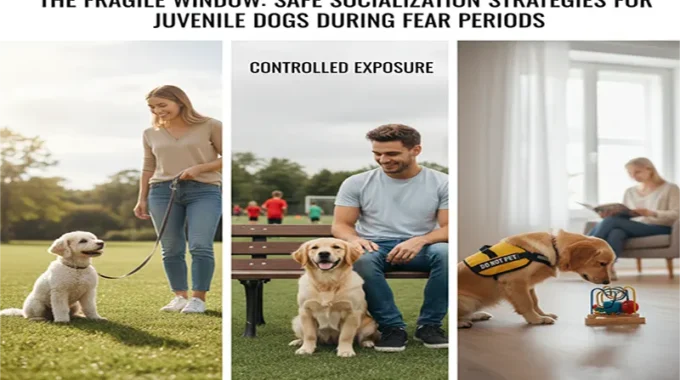
For many dog owners, the “Fear Period” feels like a sudden betrayal. One day you have a confident pup, and the next, they are cowering at a flapping leaf or barking frantically at a friendly neighbor. This isn’t a training failure; it is a biological milestone.
In canine development, fear periods are evolutionary survival mechanisms. However, in our modern world, these windows are incredibly delicate. During these times, dogs are prone to Single-Event Learning—a phenomenon where a single negative experience can create a lifelong phobia. Navigating this “fragile window” requires a shift from traditional training to proactive emotional management.
Introduction: What is a Fear Period?
Fear periods are distinct phases where a dog’s brain becomes hyper-sensitized to perceived threats.
- The First Fear Period (8–11 Weeks): Occurring during the initial puppy socialization window, this phase coincides with the time puppies usually leave their mothers. Nature designed this to keep “bold” puppies from wandering too far from the pack.
- The Second Fear Period (6–14 Months): Also known as the “Adolescent Fear Period.” This is often more jarring for owners because the dog is larger and more vocal. It correlates with sexual maturity and the brain’s Synaptic Pruning, as the dog re-evaluates what in their territory is actually “safe.”
The Neurobiology of Fear
During a fear period, the Amygdala (the brain’s emotional “fire alarm”) becomes more reactive than the Hippocampus (the memory and learning center). This means the dog is physically incapable of “thinking” their way out of a scare.
The physiological impact of an exposure can be represented by the relationship between the intensity of the trigger and the resulting stress response ($C$ for Cortisol):
$$C = \frac{I \times D}{P}$$
Where:
- $I$ = Intensity (How loud/close/big is the trigger?)
- $D$ = Duration (How long is the dog exposed?)
- $P$ = Predictability (Did the dog see it coming, or was it a surprise?)
If $I$ and $D$ are high while $P$ is low, the cortisol spike is massive, leading to Sensitization—making the dog more afraid the next time they see the trigger.
The “Quality Over Quantity” Rule
The most damaging advice in dog ownership is: “Your dog needs to meet 100 people in 100 days.” During a fear period, this is a recipe for disaster.
Socialization is not about interaction; it is about Environmental Neutrality. The goal isn’t for your dog to love everything; it’s for your dog to feel “fine” about everything. Forcing a dog to “say hello” to a stranger when they are in a fear period is not socializing; it is Flooding, which can cause the dog to shut down or become “fear-aggressive.”
Identifying the Threshold
To keep a dog safe, you must recognize the “Yellow Zone”—the moment before the dog enters a full-blown fear response.
- Yellow Zone (Caution): Lip licking, “whale eye” (showing the whites of the eyes), ears pinned back, or a sudden refusal to eat high-value treats.
- Red Zone (Over-Threshold): Freezing, frantic barking, lunging, or “pancaking” to the ground.
The 3-Second Rule: If your dog chooses to sniff a person or object, allow it for three seconds, then encourage them to move away. This prevents the dog from getting “stuck” in an interaction that might eventually overwhelm them.
Safe Socialization Strategies
Strategy 1: The Observation Post
Park your car in a busy lot or sit on a far-away bench. Let your dog watch the world move by. They are learning that the world is a “background movie” that doesn’t require a reaction. Distance is your best friend.
Strategy 2: Counter-Conditioning
This is the “See a Spark, Eat a Shark” method. The moment your dog notices a trigger (a bicycle, a bearded man), feed them a high-value treat before they react. You are changing the emotional response from “Oh no, a bike!” to “Oh boy, a bike means chicken!”
Strategy 3: Choice-Based Socialization
Always give your dog an exit. Use a long leash and let them choose the distance. If they want to move away, move with them. This builds Self-Efficacy—the dog’s belief that they have the agency to keep themselves safe.
What to Do if a “Spook” Happens
Despite our best efforts, the world is unpredictable. If your dog has a “bad” experience (a car backfires or a loose dog rushes them), follow the Recovery Plan:
- Immediate Exit: Increase distance immediately. Do not try to “show them it’s okay” in the moment.
- The Cortisol Reset: It takes 48 to 72 hours for stress hormones to return to baseline. For the next three days, avoid all known triggers. Stick to “boring” walks and lots of sleep.
- Check for Trigger Stacking: Remember that small stresses add up. A dog who was “fine” with a vacuum yesterday might bark today because they are still recovering from a scare at the park this morning.
Socialization vs. Over-Stimulation
| Activity | Goal | Warning Signs of Overload |
| Store Visit | Neutrality to carts/noises | Panting, pulling to the exit, ignoring treats. |
| Play Date | Social skills with known dogs | “Zoomies” that look frantic, pinning other dogs. |
| Park Watch | Observing movement | Staring intensely (fixating) without blinking. |
| Greeting People | Positive association | Tucked tail, submissive urination, backing away. |
The Role of the Owner: The Secure Base
There is a persistent myth that “comforting a fearful dog rewards the fear.” This is scientifically incorrect. Fear is an emotion, not a behavior. You cannot reinforce an involuntary emotional response with a hug or a kind word.
By providing comfort, you act as a Secure Base. When the dog knows they can retreat to you for safety, they become more confident in exploring the world, not less.
Fear-Free Tip: Distance is Safety
If your dog is barking, they are telling you they need more space. Instead of shushing them, simply turn around and walk away. Once the dog feels safe, their brain can return to a state where learning is possible.
Socialization during a fear period is an exercise in restraint. It’s okay to tell a stranger, “No, he’s in training, please don’t pet him.” Your priority is the long-term mental health of your dog, not the feelings of a passerby. By prioritizing Desensitization and respecting your dog’s threshold, you will navigate the fragile window and emerge with a resilient, confident adult dog.