
If you are a dog owner dealing with a pet suffering from severe skin allergies, you know the heartbreak of the “itch-scratch cycle.” The constant licking, the red and inflamed “hot spots,” the recurring ear infections, and that distinct corn-chip smell are more than just a nuisance—they are signs of a dog in distress.
When standard “limited ingredient” over-the-counter diets fail, veterinarians turn to the gold standard of allergy management: Hydrolyzed Protein Diets.
The Science of Itch: Food Sensitivity vs. Severe Allergy
It is important to distinguish between a food intolerance (digestive upset) and a true Food Allergy. A food allergy is an immune system overreaction. When a dog with a beef allergy eats beef, their immune system identifies the large protein molecules as invaders. This triggers the release of histamines, leading to Atopic Dermatitis (skin inflammation).
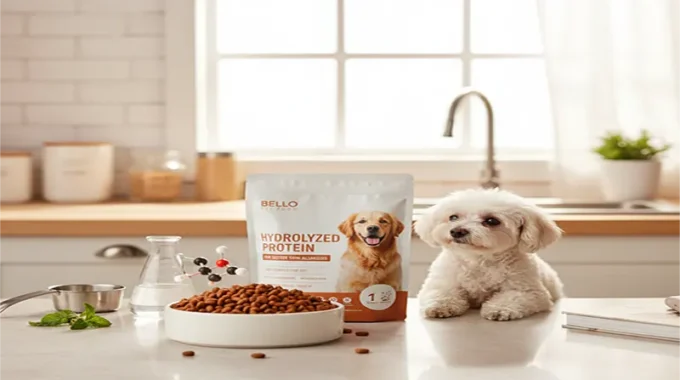
Hydrolyzed protein is the “stealth mode” of canine nutrition. In these diets, the protein is chemically “shattered” so the immune system never even sees it coming.
How Hydrolysis Works: The Molecular Breakdown
To understand hydrolysis, imagine a large, complex Lego castle. This represents a whole protein molecule, such as chicken or beef. If a dog is allergic, their immune system recognizes the specific shape of that “castle” and attacks.
In the process of hydrolysis, water is used to break the chemical bonds of the protein, dismantling the “castle” into individual bricks (amino acids and peptides). Because the immune system only reacts to proteins above a certain molecular weight—typically measured in Daltons—the goal of these diets is to keep the peptides extremely small.
Most hydrolyzed diets ensure that the protein fragments are smaller than $10,000$ Daltons, while some specialized formulas go as low as $1,000$ to $3,000$ Daltons. At this size, the protein is essentially “invisible” to the dog’s IgE antibodies.
The “Big Three” Veterinary Formulas for 2026
When dealing with severe, chronic cases, these three formulas are the most clinically backed options available.
1. Royal Canin Veterinary Diet Hydrolyzed Protein HP
Royal Canin is often the first choice for vets because of its incredibly strict manufacturing process. They use dedicated lines to ensure there is zero cross-contamination with other proteins.
- Protein Source: Soy protein isolate.
- The Science: Soy is highly digestible and rarely an allergen in dogs compared to animal proteins.
- Key Benefit: High levels of B vitamins and amino acids to support the “skin barrier” (the physical shield of the skin).
Vet’s Tip: If your dog has a history of calcium oxalate stones along with allergies, Royal Canin’s HP diet is formulated to promote a urinary environment unfavorable to stone formation.
2. Hill’s Prescription Diet z/d Skin/Food Sensitivities
Hill’s z/d is perhaps the most famous hydrolyzed diet on the market. It is specifically designed to be the “cleanest” possible option for a diagnostic trial.
- Protein Source: Hydrolyzed chicken liver.
- The Science: By using only the liver and then hydrolyzing it, they remove the muscle-meat proteins that typically trigger reactions.
- Key Benefit: Includes ActivBiome+ technology—a proprietary blend of prebiotics designed to quickly nourish the gut microbiome, which is often damaged in allergic dogs.
Vet’s Tip: For dogs that find dry kibble unappealing, Hill’s z/d offers one of the most palatable canned (wet) versions, which can be life-saving for picky eaters during an allergy trial.
3. Purina Pro Plan Veterinary Diets HA Hydrolyzed
Purina HA is unique because it offers multiple protein “flavors” within the hydrolyzed category, including Vegetarian (Soy) and Salmon.
- Protein Source: Hydrolyzed soy or hydrolyzed salmon.
- The Science: It is formulated with low-allergen carbohydrates (like corn starch) to further reduce the risk of a reaction.
- Key Benefit: It is exceptionally calorie-dense and highly digestible, making it a great choice for dogs who have lost weight due to chronic illness.
Vet’s Tip: If your dog is a “meat snob” and refuses the soy-based Royal Canin or Hill’s, the Salmon-flavored Purina HA is often the bridge to getting them to eat a prescription diet.
Comparison of Leading Hydrolyzed Diets
| Brand | Primary Protein | Form | Prescription Required? | Best For |
| Royal Canin HP | Hydrolyzed Soy | Dry & Wet | Yes | Strict cross-contamination control |
| Hill’s z/d | Hydrolyzed Chicken Liver | Dry & Wet | Yes | Fast gut/microbiome recovery |
| Purina HA | Hydrolyzed Soy or Salmon | Dry | Yes | Picky eaters / High digestibility |
| Blue Buffalo HF | Hydrolyzed Salmon | Dry | Yes | Owners preferring grain-free options |
The Elimination Diet Protocol: The 8-12 Week Rule
To know if the food is actually working, you must perform a strict Elimination Diet. This is not a “suggestion”; it is a clinical trial.
- The Purge: Stop all current food, treats, flavored medications (ask your vet about non-flavored heartworm/flea prevention), and table scraps.
- The Transition: Gradually mix the hydrolyzed food with the old food over 7 days to avoid diarrhea.
- The Strict Phase: For 8 to 12 weeks, the dog eats only the hydrolyzed kibble and water.
- Monitoring: Use a journal to track “Itch Levels” on a scale of 1-10. Usually, gastrointestinal symptoms improve in 2-4 weeks, while skin takes the full 12 weeks to heal.
Common Pitfalls: Why Hydrolyzed Diets “Fail”
If your dog is still itching after six weeks on a hydrolyzed diet, it usually isn’t the food’s fault. Common culprits include:
- Flavored Medications: Many monthly chewable heartworm and flea preventatives are flavored with real beef or pork. This is enough to trigger a severe allergy.
- The “Grandparent” Factor: A single “illegal” treat (a piece of cheese or a crust of bread) can reset the entire 12-week clock.
- Secondary Infections: If your dog has an active yeast or bacterial infection on the skin, the food won’t cure it. The infection must be treated with medication while the food prevents new inflammation.
- Environmental Allergies: Some dogs have “double trouble”—they are allergic to food and pollen/dust mites. If the food helps but doesn’t 100% cure the itch, environmental factors are likely involved.
A Roadmap to Healing
Severe skin allergies are exhausting for both the dog and the owner. While hydrolyzed protein diets are more expensive than standard kibble, they are often cheaper than a lifetime of Apoquel, Cytopoint injections, and emergency vet visits for hot spots.
Once the 12-week trial is over and your dog’s skin has cleared, you have a baseline of health. From there, you and your vet can decide whether to stay on the hydrolyzed diet for life or slowly “challenge” the immune system by introducing one single whole protein at a time to see what triggers a flare-up.