
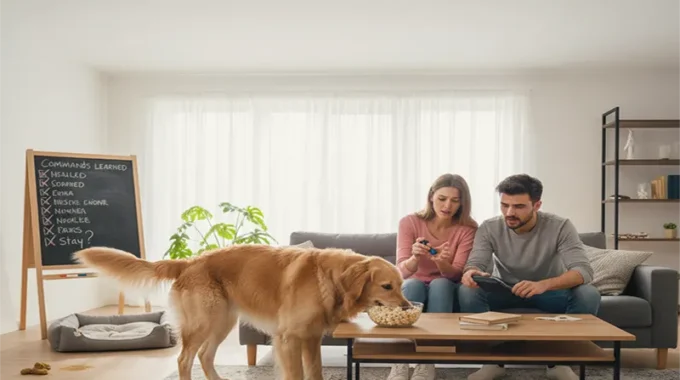
One day, you have a star pupil: a four-month-old puppy who sits on command, follows your every move, and has a recall that would make a sheepdog jealous. Then, seemingly overnight, that same dog looks at you when called, tilts their head as if you’re speaking an ancient, forgotten language, and decides that a discarded candy wrapper across the street is infinitely more interesting than your high-value liver treats.
Welcome to canine adolescence.
Occurring roughly between 6 and 18 months (depending on the breed), this phase is the “Great Testing.” It is the primary reason dogs are surrendered to shelters. But before you conclude that your dog has “gone bad” or that you’ve failed as a trainer, it’s time to look under the hood. Your dog isn’t being spiteful; their brain is quite literally under construction.
The “Teenage” Brain: Biological Rewiring
During adolescence, a dog’s brain undergoes a massive overhaul known as Synaptic Pruning. The brain is streamlining its connections, getting rid of what it thinks it doesn’t need and strengthening what it does. Simultaneously, the prefrontal cortex—the area responsible for impulse control and decision-making—is the last part to fully develop.
While the “logic center” is offline, the amygdala (the emotional center) is working overtime. This is fueled by a surge in gonadal hormones (even in neutered dogs, as the adrenal glands also play a role). In scientific terms, we can look at the relationship between stimulus and the dog’s internal state as:
$$\text{Arousal} \propto \frac{\text{Stimulus Intensity}}{\text{Impulse Control}}$$
When impulse control is low due to biological pruning, even a minor stimulus results in a massive spike in arousal.
Common Symptoms of Adolescence
1. Selective Hearing
This is the hallmark of the teenage dog. It isn’t that they’ve forgotten the word “Come”; it’s that the environmental rewards (smells, squirrels, other dogs) now offer a higher dopamine hit than your praise. Their world has expanded, and you are no longer the sole center of it.
2. The Second Fear Period
Somewhere between 6 and 14 months, many dogs enter a Second Fear Period. You might find your previously brave dog barking at a mailbox or refusing to walk past a parked bicycle. This is a survival mechanism where the brain re-evaluates what is safe and what is a threat.
3. Increased Distractibility
Adolescents become “environment-focused” rather than “owner-focused.” Their noses become ultra-sensitive, and their desire to explore territory often overrides their desire to please you.
The Science of Training Regression
Regression is not a loss of intelligence; it is a shift in priority and dopamine rewards. In early puppyhood, your dog was biologically tethered to you for survival. As an adolescent, the biological drive shifts toward independence and “scouting.”
Because their threshold for arousal is much lower, they reach a state of “over-threshold” much faster. Once a dog is over-threshold, their “thinking brain” shuts off, and they move into a reactive state. Training during this phase isn’t about teaching new tricks; it’s about maintaining Environmental Neutrality.
Phase 1: Back to Basics (Management)
If you can’t control the dog’s brain, you must control their environment. This is the “Management” phase.
- Shrink Their World: If your dog’s recall has failed, they lose off-leash privileges. Use a 15-to-30-foot long line to allow freedom while maintaining safety.
- Increase Reward Frequency: You are competing with the world now. If you were using kibble for training, it’s time to upgrade to roast chicken or string cheese.
- The “Reset” Rule: If a dog fails a command twice, they aren’t “being stubborn”—they are likely too distracted or over-stimulated. Move further away from the distraction and try again at an easier level.
Trainer’s Secret: The Premack Principle
This is the “Grandma’s Law” of dog training: “Eat your vegetables, and you get dessert.” If your dog wants to sniff a certain bush, make them sit first. The reward for the sit isn’t a treat; it’s the permission to go sniff. You are teaching the dog that you are the gateway to the things they want.
Phase 2: Biological Fulfillment
An adolescent dog with “nothing to do” will find a job, and you usually won’t like the job they choose (like “Interior Decorator of the Sofa”).
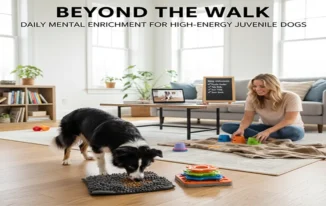
- Sniffaris: Instead of a brisk “heeling” walk, go for a Sniffari. Let the dog lead with their nose on a long leash. Ten minutes of intense sniffing is more exhausting for an adolescent brain than a 30-minute run.
- Foraging: Stop feeding out of a bowl. Use puzzle feeders, snuffle mats, or scatter kibble in the grass. This taps into their natural foraging instincts and provides a calm, dopamine-releasing activity.
Troubleshooting Table: The Adolescent Edition
| Common Issue | Underlying Cause | Immediate Training Fix |
| Recall Regression | Increased environmental value. | Use a long line; never call the dog for “bad” things (like ending a walk). |
| Leash Pulling | High arousal and “frustrated greed.” | Practice “Penalty Yards”—if the leash goes tight, you stop or walk backward. |
| Sudden Barking | Second fear period / Hyper-vigilance. | Counter-Conditioning: Feed treats the moment they see the “scary” thing. |
| Destructive Chewing | Jaw development and boredom. | Provide varied textures (rubber, wood-chews, frozen treats). |
Phase 3: Strengthening the Bond
In this phase, stop focusing on “Obedience” (the dog doing what you say) and start focusing on Engagement (the dog wanting to be with you).
- The “Look at Me” Game: Whenever your dog looks at you voluntarily on a walk, mark and reward. You are rewarding the choice to check in.
- Play-Based Training: Incorporate tug or fetch into your training. A dog who plays with their owner is a dog who pays attention to their owner.
The Owner’s Mental Health: Patience and Persistence
The “Teenage Terror” is a season, not the destination. It is incredibly frustrating to feel like your “perfect puppy” has vanished, but the work you put in now is what solidifies the adult dog they will become.
Avoid “Alpha Rolling” or harsh corrections. Because the adolescent brain is already prone to fear and high arousal, punishment often backfires, leading to a breakdown in the bond and increased reactivity. Think of yourself as a coach, not a drill sergeant.
Managing an adolescent dog is an exercise in deep patience. By understanding that their brain is undergoing Synaptic Pruning and that their “defiance” is actually a biological inability to focus, you can shift your perspective from frustration to empathy.
Focus on management, keep your rewards high, and remember: the dog you see today is not the dog you will have forever. Stay consistent, keep it fun, and you will eventually emerge from the teenage fog with a loyal, reliable adult companion.