
In the high-stakes environment of 2026 Whiteout Survival, the role of a Rally Leader has evolved. Gone are the days when simply having the highest “Base Attack” was sufficient to steamroll an opponent. The current meta is defined by Damage Mitigation, Lethality scaling, and Garrison Breaching.
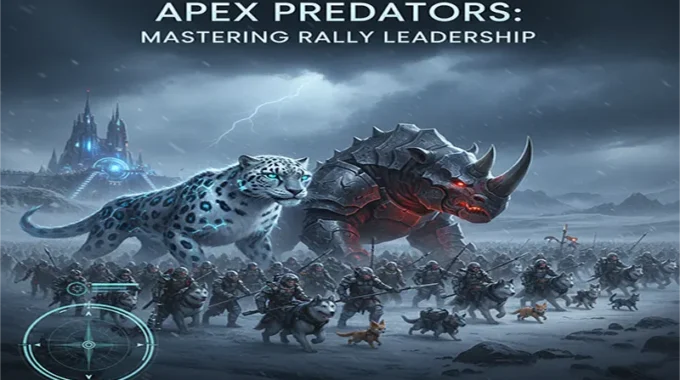
To lead a successful rally against a reinforced Sunfire Castle or a maxed-out Facility, a leader must master two distinct “Apex Predators”: the Snow Leopard and the Iron Rhino. While the Leopard is your surgical blade, designed to shred troops with high-velocity strikes, the Rhino is your sledgehammer, built to crack the toughest shells.
The Snow Leopard: The Surgical Striker
The Snow Leopard remains the premier offensive pet for one reason: it scales better than any other beast when your Lethality is high.
Savage Bash and the First Strike
The Leopard’s core skill, Savage Bash, provides a massive burst of damage in the opening rounds of combat. In Whiteout Survival, the first 10 seconds of a rally often determine the outcome; if you can wipe out the enemy’s front-line Infantry early, your Marksmen can begin targeting their Lancers and Marksmen without obstruction.
The math behind the Leopard’s dominance is centered on the interaction between $Lethality$ and $Enemy$ $Health$. The effectiveness of your strike can be modeled as:
$$\text{Kill Efficiency} = \frac{\text{Lethality} \times (1 + \text{Crit Multiplier})}{\text{Enemy Health} \times \text{Damage Reduction}}$$
By maximizing the Leopard’s passive Lethality nodes, you ensure that your damage isn’t just “wounding” the garrison—it is deleting it.
The Iron Rhino: The Siege Engine
While the Leopard focuses on your own damage output, the Iron Rhino focuses on the enemy’s weakness. The Rhino is specifically designed for “Siege” scenarios where the opponent has a massive Infantry wall reinforced by defensive heroes like Patrick or Jessie.
Tectonic Stomp and Armor Shredding
The Rhino’s signature 2026 skill, Tectonic Stomp, applies a “Fracture” debuff to the enemy garrison. This debuff ignores a percentage of the enemy’s Garrison Defense. When facing a “Meat Shield” setup (an opponent with $80\%+$ Infantry), the Leopard’s flat damage often hits a wall. The Rhino, however, creates a “breach” that allows your Lancers to deal significant damage to the backline.
Formation Synergy: Matching Troops to Pets
A common mistake is using the same troop ratio for both pets. To be an elite leader, you must adapt your formation to the beast you are leadng with.
The Leopard Formation (20/20/60)
The Snow Leopard thrives on a Marksman-Heavy setup.
- Infantry (20%): Just enough to provide a buffer.
- Lancers (20%): To provide secondary pressure.
- Marksmen (60%): These are the “Leopard’s Claws.” Since the Leopard boosts Lethality, you want as many high-damage units as possible to benefit from that stat.
The Rhino Formation (40/10/50)
The Iron Rhino is built for Attritional Warfare.
- Infantry (40%): You need a thick wall to survive while the Rhino’s “Fracture” debuff stacks on the enemy.
- Lancers (10%): Reduced count, as your goal is sustain, not speed.
- Marksmen (50%): To capitalize on the shredded defense.
Refinement Priorities for Leaders
To ensure your rally is the strongest in the State, your refinement strategy must be clinical.
For the Snow Leopard:
- Lethality (Red/Mythic): Non-negotiable.
- Attack (Orange/Red): To raise the base damage floor.
- March Capacity: Crucial for Rally Leaders.
The scaling of Rally Capacity $(C)$ vs. Total Damage Output $(D)$ is:
$$D = \sum_{i=1}^{n} (T_i \times P_i) \times (1 + \text{Pet Multiplier})$$
Where $T$ is the number of troops and $P$ is individual troop power. Even a $5\%$ increase in Rally Capacity often outweighs a $10\%$ increase in raw Attack.
For the Iron Rhino:
- Damage Reduction %: To keep your Infantry alive longer.
- Health: To synergize with the Rhino’s defensive buffs.
- Enemy Defense Reduction: To double down on its “Siege” role.
The Hero-Pet Connection
The synergy between your Heroes and your Pets can create “God-Tier” rallies.
- Snow Leopard + Marksman Heroes (e.g., Rene/Gen 9 Leads): This combination focuses on total annihilation. If your heroes provide a $Crit$ buff, the Leopard’s Lethality turns every hit into a death sentence for the enemy.
- Iron Rhino + Defensive/Utility Heroes (e.g., Hector/Ahmose): This setup is designed to “outlast” the enemy. As the battle progresses, the Rhino’s debuffs get stronger while your heroes maintain the frontline.
Rally Leader Comparison Table
| Metric | Snow Leopard | Iron Rhino |
| Burst Damage | Extreme (First 5 Rounds) | Moderate |
| Sustain | Low | High |
| Best Target | Weakly reinforced cities / Arena | Maxed Garrisons / Sunfire Castle |
| Core Stat | Lethality | Defense Shred |
| CC Level | None (Raw Damage) | High (Debuffs/Stuns) |
The “Counter-Rally” Strategy
In a Sunfire Castle battle, the situation changes every minute. An elite leader monitors the garrison report.
- Switch to Leopard: If the enemy garrison is low on Infantry. You want to wipe them out before they can reinforce.
- Switch to Rhino: If the enemy just reinforced with $500,000$ T11 Infantry. You need the Rhino to shred that new armor.
🛰️ War Room Tip: The Skill Swap
Did you know you can “Quick-Swap” pet skills? During the long march toward the Castle, you can keep Wild Marks saved and swap the Snow Leopard’s passive skills to March Speed to arrive faster, then swap back to Lethality seconds before impact for maximum damage.
Mastering the Snow Leopard and the Iron Rhino is the difference between a Rally Leader who merely participates and one who dominates. In 2026, the meta demands versatility. You must be prepared to use the Leopard for surgical, high-lethality strikes and the Rhino for grinding down the most stubborn defenses. Ensure both pets are at a minimum of Orange Tier and focus your Refinement Stones on the stats that support their specific roles.