
Bringing home a new kitten is a moment of pure joy for the human members of the family. However, for your resident adult cat, that tiny ball of fluff represents something much more sinister: a territorial intruder, a resource thief, and an unpredictable “chaos agent.”
Cats are evolutionarily wired to be “control freaks” about their environment. In the wild, a strange cat in one’s territory usually means a fight for food or mating rights. To ensure your home doesn’t become a feline battlefield, you must move slow. The goal is a “scent handshake” that builds a Positive Association long before the cats ever lock eyes.
Phase 1: The Sanctuary Room (Days 1–3)
The biggest mistake owners make is the “sink or swim” method—dropping the kitten in the living room and hoping they work it out. This often leads to immediate aggression and long-term trauma.
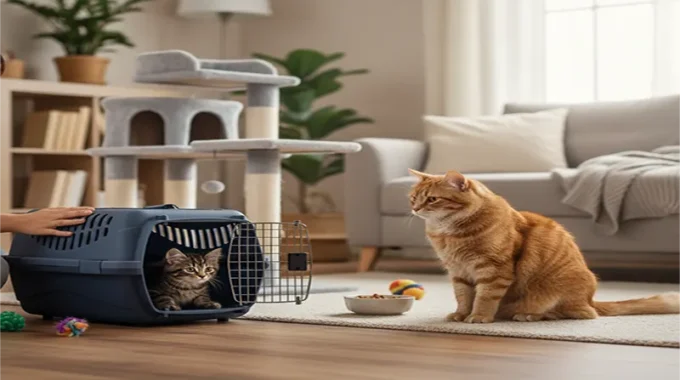
Instead, create a Base Camp for the kitten. This should be a separate room (like a bathroom or guest bedroom) equipped with its own litter box, food, water, and scratching post.
- For the Kitten: It provides a safe, manageable space to adjust to new sounds and smells without being overwhelmed.
- For the Resident Cat: It keeps their main territory (the living room, your bedroom) intact. They will know something is in that room, but they won’t feel immediate pressure to defend their space.
Phase 2: The Scent Handshake (Days 3–5)
Cats communicate primarily through smell. Before they see each other, they need to “know” each other’s scent profile.
Scent Swapping
Take a clean sock or small cloth and gently rub it against the kitten’s cheeks (where their scent glands are located). Place that sock near your resident cat’s favorite sleeping spot. Do the same with a cloth rubbed on the resident cat and give it to the kitten. If the resident cat hisses at the sock, don’t worry—that’s just a “commentary” on the situation. Continue until they can sniff the cloth without a negative reaction.
Site Swapping
Once both cats are calm, perform a “room swap.” Put the resident cat in the kitten’s Base Camp and let the kitten explore the rest of the house. This allows the resident cat to investigate the “intruder’s” scent in a space where the intruder isn’t actually present. It helps the adult cat realize that the kitten’s scent doesn’t mean an immediate threat to their safety.
Phase 3: The “Under the Door” Connection
The next step is to associate the other cat’s presence with the best thing in the world: food. Start feeding both cats on opposite sides of the closed door to the Base Camp.
At first, place the bowls several feet away from the door. Gradually move the bowls closer each mealtime until they are eating just inches apart with only the door between them. They are now learning that the “smell of the other cat” equals “delicious dinner.”
Phase 4: Visual Introduction (The Barrier Method)
Once they can eat calmly at the door, it’s time for visual contact. Do not remove the door entirely. Instead, use a baby gate or a door prop that allows for a 1-to-2-inch crack.
Use High-Value Treats—like Churu, tuna, or boiled chicken—during these sessions. You want them to look at each other, eat something amazing, and then have the door closed again. Keep these sessions short (under 5 minutes) and always end on a high note.
Phase 5: The First Face-to-Face
When both cats can eat treats while looking at each other through a gate without growling or excessive hissing, you can move to a supervised, open-room meeting.
- Vertical Space is Mandatory: Ensure your adult cat has access to cat trees, shelves, or the back of a sofa. Height equals safety for a cat. If they feel crowded by a kitten’s energy, they need to be able to retreat upward.
- The “No-Touch” Rule: Do not pick one cat up and force them toward the other. Let them move at their own pace.
- Distract, Don’t Discipline: Use a wand toy to keep the kitten’s focus away from stalking the older cat.
Special Case: Kittens and Senior Cats
Senior cats (ages $10+$ years) have lower energy and may suffer from arthritis. A pouncing kitten isn’t just annoying; it can be physically painful. For seniors, the introduction period should be doubled. Ensure the senior cat has “Kitten-Free Zones” where the younger cat is never allowed to go, preserving the senior’s peace and quiet.
Warning Signs and Troubleshooting
It is normal to hear a small hiss or a “get away from me” bat. This is how adult cats set boundaries. However, you must intervene if you see:
- Piloerection: The “Halloween cat” look with fur standing on end.
- Dilated Pupils and Flattened Ears: Signs of extreme fear or imminent attack.
- Resource Guarding: One cat preventing the other from accessing the litter box or food bowl.
If a real fight breaks out (screaming, fur flying), do not use your hands to separate them. Use a piece of cardboard or a loud noise to distract them, then move the kitten back to Base Camp. This is the “Back-to-Basics” rule: if things go south, return to Phase 1 for a few days to let stress hormones ($Cortisol$) dissipate.
The Role of Pheromones
To lower the overall environmental tension, many behaviorists recommend synthetic pheromone diffusers, such as Feliway Multicat. These mimic the “maternal appeasing pheromone” that mother cats produce to calm their litters. While not a “magic wand,” they can reduce the intensity of hissing and help the resident cat feel more secure in their territory during the transition.
The Timeline of Friendship
Every cat is an individual. Some introductions conclude with the cats grooming each other within 48 hours; others remain in a state of “polite roommates” for months. The average successful introduction takes roughly 2 to 4 weeks.
Patience is your greatest tool. By respecting your adult cat’s territorial instincts and allowing the kitten to earn their place slowly, you aren’t just preventing a fight—you are building the foundation for a lifelong bond.